
Cape Town in summer is pure magic. The sun rises over the Atlantic, consistent southwest swells rolling into Muizenberg, and that unmistakable buzz at every beach break from Long Beach to Llandudno. Whether you are a weekend warrior chasing your first green wave or a seasoned charger hunting barrels at Dungeons, one truth remains: surfing here is addictive, and the ocean does not hand out free passes.
Yet every November, as the water warms and the car parks fill, my appointment book as a Cape Town orthopaedic surgeon starts filling with the same familiar stories. A paddler with a sharp pain in the shoulder that will not go away after a long session at Scarborough. A knee that buckles on the pop-up at Big Bay. A hip that clicks and grabs every time they bottom-turn. These are not rare misfortunes, they are predictable consequences of a sport that asks repetitive, asymmetrical loads from the shoulder, explosive power from the knee, and rotational torque from the hip, often in cold water and fatigue.
The problem is simple: most surfers spend far more time preparing their boards than preparing their bodies. By the time pain arrives, the damage is already underway.

The Hidden Cost of Ignoring Early Warning Signs
Let us be honest. When your shoulder starts aching after a three-hour session, the usual response is “I’ll just paddle less tomorrow” or “It will settle once the swell dies.” That rarely happens. Paddling accounts for up to 70 % of time spent surfing, and the overhead, repetitive motion creates the perfect recipe for rotator cuff tendinopathy and impingement. Ignore it for one season and you are looking at a partial-thickness tear that benches you for six to nine months.
Knees take a different kind of punishment. The explosive pop-up on an unstable, moving platform, combined with duck-diving and wiping out in shallow reef, frequently overloads the medial collateral ligament and meniscus. In professional surfers, knee injuries are the single most common reason for missed contests. In recreational surfers I see in Cape Town, many present only after the knee has started giving way on dry land, which usually means the cartilage damage is already significant.
Hips are the silent sufferer. The deep flexion and rapid rotation needed for cutbacks and snaps irritates the hip flexor tendons and can tear the labrum, the cartilage ring that keeps the joint stable. Once that labrum is frayed, every bottom turn sends a stab of pain into the groin and the joint starts wearing out faster than it should.
The consequences go beyond missing a few swells. Chronic shoulder impingement can become frozen shoulder. Unstable knees accelerate osteoarthritis in your thirties. Damaged hip labrums are one of the leading causes of early hip replacements in former athletes. I have replaced hips in ex-surfers in their mid-40s who thought “it was just tightness.”
A Practical Framework to Stay in the Water Longer
Good news: almost all of these injuries are preventable, and the ones that do happen respond dramatically better when caught early. Here is the exact system I give my patients who surf, the same one that keeps many Cape Town regulars charging well into their 50s and 60s.
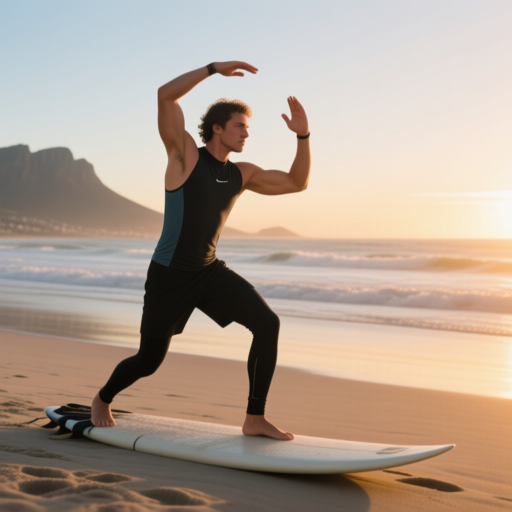
Step 1: Pre-Surf Land Warm-Up (8–10 minutes – non-negotiable)
Most surfers jump straight from the car park into the lineup. That is like asking your engine to red-line from cold. A proper dynamic warm-up raises tissue temperature, lubricates joints, and activates the stabilising muscles you are about to rely on.
Simple routine:
- Arm circles and band pull-aparts × 20 each direction (wakes up the rotator cuff and scapular stabilisers)
- Thoracic rotations on all fours × 15 per side (opens the upper back so your shoulders do not have to overreach)
- Bodyweight squats to downward dog × 10 (activates glutes and lengthens hip flexors)
- Single-leg balance reaches × 10 per leg (fires up the knee stabilisers before the pop-up)
Do this every session. It feels tedious the first week, then becomes as automatic as waxing your board.
Step 2: In-Water Progressions and Technique Tweaks
- Paddle with a higher elbow catch and wider hand entry to reduce impingement angle.
- Keep your non-dominant arm slightly longer on the pop-up to spare the dominant knee.
- Practise “chicken wing” free pop-ups on the sand first, this reduces the explosive valgus load that blows out MCLs.
- Wear booties even in summer water below 17 °C, cold muscles and ligaments are far more likely to tear.
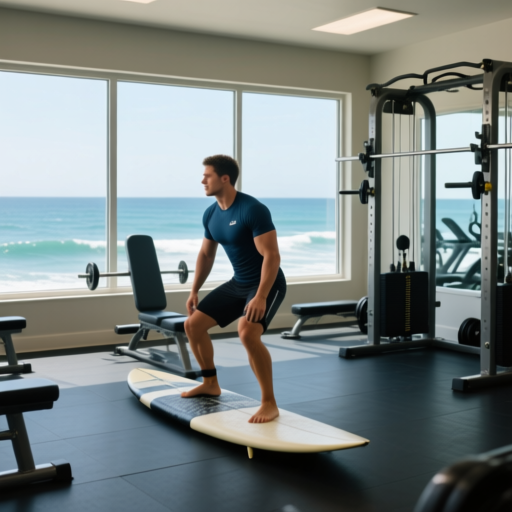
Step 3: Off-Water Strength and Mobility (3 × 30-minute sessions per week)
The surfers who almost never visit my rooms as patients all do some version of this:
Shoulder prehab
- External rotation with light band or dumbbell (3 × 15–20)
- Y-T-W raises on incline bench (scapular strength)
- Face pulls or rear-delt flies
Knee resilience
- Spanish squats or heel-elevated squats with band around knees (vastus medialis emphasis)
- Single-leg Romanian deadlifts
- Lateral band walks
Hip stability and mobility
- 90/90 hip shifts and Cossack squats
- Copenhagen side planks (adductor strength is the secret knee protector most surfers miss)
- Pigeon stretch and couch stretch daily
Do these consistently and your joints will handle the beating the Indian Ocean dishes out.
Step 4: Recognise Red Flags Early
If any of these appear, book an appointment sooner rather than later:
- Pain at night or when lying on the affected shoulder
- Knee swelling that lasts more than 48 hours after a session
- Clicking, catching, or deep groin pain when changing direction
- Weakness that stops you completing normal manoeuvres you used to do easily
As a Cape Town orthopaedic surgeon who specialises in knee, hip, and shoulder conditions, I would far rather see you for a 20-minute assessment and some targeted physiotherapy than perform arthroscopic surgery six months later. Modern keyhole techniques for rotator cuff repair, meniscus preservation, and hip labral reconstruction have excellent outcomes, but prevention or early intervention always beats orthopaedic surgery.
Making This Summer Your Best (and Healthiest) Yet
Cape Town’s summer lineup is a gift. The dawn patrols at Muizenberg when the offshore grooms the peaks, the sunset sessions at Llandudno when the water turns gold, the road trips up the West Coast chasing uncrowded points, none of that needs to be sacrificed to injury.
Spend ten minutes warming up, thirty minutes a few times a week strengthening the right muscles, and listen to the small warning signals your body gives you. Do that, and you will still be surfing your favourite breaks long after your mates have traded their boards for golf clubs.
If something does not feel right this season, reach out. Comprehensive orthopaedic care for knee, hip, and shoulder problems is available right here in Cape Town, and getting you back in the water safely is what we do best.
See you in the lineup.
Stay safe, paddle strong, and respect the ocean, it will respect you back.
Frequently Asked Questions
- Which joint is most commonly injured by Cape Town surfers I see?
Shoulders from chronic paddling, followed closely by knees after wipeouts on shallow reefs. Hips are less frequent but often the most overlooked until damage is advanced. - Can I surf with mild shoulder impingement?
Mild cases often improve with rest, physiotherapy, and technique changes, but continuing to paddle through pain usually worsens the problem. A quick assessment can tell you whether you need a short break or just better prehab. - How long after knee meniscus surgery can I return to surfing?
Most patients are walking normally within days and back on a board comfortably at 10–14 weeks with a structured rehab program. Aggressive return too early risks re-tear. - Are there specific exercises for hip labral tears from surfing?
Yes, strengthening the deep hip stabilisers and improving thoracic mobility reduce stress on the labrum. Many surfers manage symptoms non-operatively; surgery is reserved for persistent mechanical catching or groin pain at night. - When should I worry about knee instability after a wipeout?
If the knee swells significantly, feels loose when walking on sand, or gives way on stairs, get it checked. Early MRI can distinguish simple sprains from ACL or meniscus tears that benefit from timely intervention.
Discover how Cape Town’s spring weather flares knee and hip pain – read our recent article here…