
Don’t Let Joint Instability Spoil Your Cape Town Summer
It’s the first proper day of your summer holiday. The south easter is still asleep, Muizenberg is glassy, and you’re halfway through your paddle-out when your shoulder suddenly shifts forward with that sickening “clunk”. Or you’re jogging the Pipe Track with the family and your knee decides to slide sideways on a loose stone. One second you’re living the Cape Town dream, the next you’re wondering if the rest of summer is going to be spent on the couch with an ice pack and a WhatsApp full of “shame man” messages.
As a Cape Town orthopaedic surgeon who sees more joint instability cases in summer than the rest of the year combined, I can tell you this: that weird wobble or click is rarely “nothing”. Ignore it and you’re gambling with the best months of the year.
The Silent Summer Wrecker Almost Everyone Misdiagnoses
Joint instability is sneaky. It’s not always dramatic. Most patients describe it as “something just doesn’t feel right”.
- Your shoulder slips when you reach for the braai tongs.
- Your knee buckles slightly when you pivot to chase the beach ball.
- Your hip clicks painfully every time you stand up from the picnic blanket.
These are classic signs of ligament laxity, labral damage, or capsular stretching in the shoulder, knee, or hip. In an office-based city like Johannesburg people might live with it for years. In Cape Town, where summer means surfing, hiking, padel, and chasing kids across the sand, instability becomes impossible to hide.

The Real Cost of Pretending It’s Fine
I had a patient last December, let’s call him Ryan, a 38-year-old architect and keen surfer from Kommetjie. He felt his shoulder “pop out and back in” during a late-November session. He iced it, took two Nurofen, and convinced himself it was “just a tweak”. By New Year’s Eve he had dislocated the shoulder completely while lifting his toddler onto his shoulders at a family braai. What could have been fixed with a simple arthroscopic stabilisation in December turned into a Latarjet bone-block procedure in January and no surfing until the following spring.
The consequences go beyond missing waves:
- Recurrent micro-instability grinds cartilage and speeds up arthritis.
- One bad fall because your knee gives way on the Contour Path can tear a meniscus or ACL.
- Chronic hip instability from an old labral tear leads to early osteoarthritis by your mid-40s.
In short, Cape Town summer is the worst possible time to discover you’ve been ignoring joint instability.
Your Step-by-Step Framework to Spot and Stabilise the Wobble Before It Ruins your Summer
Here’s the exact system I teach every patient who walks into my rooms worried about knee, hip, or shoulder joint instability.
Step 1: The 30-Second Self-Test Trio (Do these today)
Shoulder
Stand in front of a mirror, arms relaxed. Slowly raise both arms sideways to shoulder height. Does one shoulder hitch upwards or feel like it wants to slide forward? That’s a positive sulcus or apprehension sign.
Knee
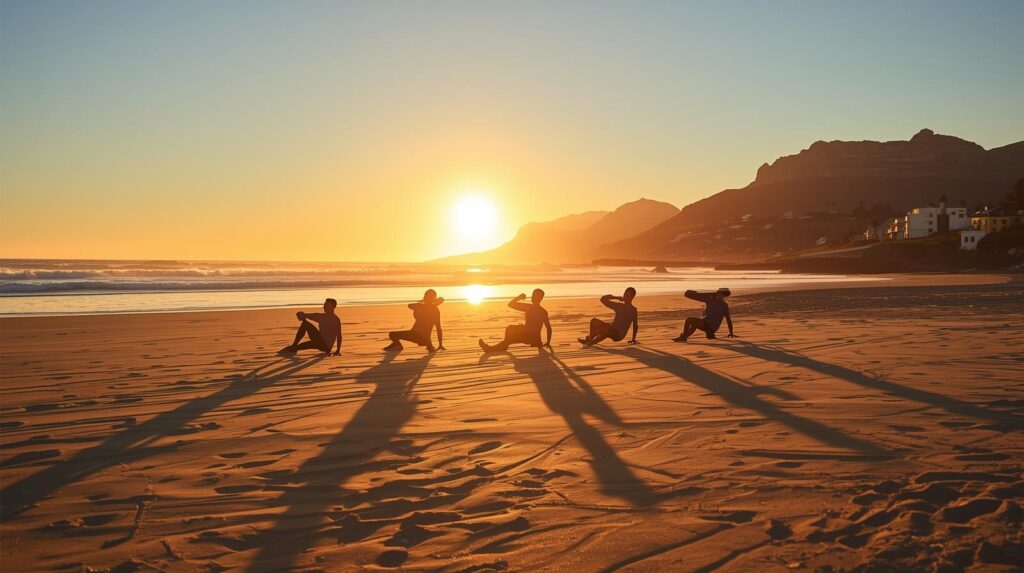
Stand on one leg with eyes closed for 10 seconds (yes, on the beach sand is fine). If the knee drifts inward or you have to grab something for balance, your stabilisers are asleep.
Hip
Lie on your back, knees bent. Gently pull one knee to your chest. Does the opposite side of your pelvis lift off the ground immediately? Weak deep hip stabilisers.
Step 2: The Traffic-Light Response System
Green (mild, occasional wobble)
- Start daily closed-chain stability exercises (see below).
- Use a lightweight neoprene sleeve or tape for high-risk days.
- Book a physio appointment within two weeks.
Yellow (frequent clicks, giving way 2–3 times a month)
- Stop high-risk sports immediately (no overhead serving in padel, no trail running).
- MRI within the next month, many Cape Town orthopaedic surgeons can arrange this quickly.
- Intensive physio focusing on proprioception.
Red (actual giving way, near-dislocations, pain at night)
- Urgent appointment, instability this severe rarely settles without orthopaedic surgery.
- Arthroscopic stabilisation success rates are over 90 % when done early.
Step 3: The Five Best Local-Friendly Joint Stability Exercises You Can Start Tomorrow
- Banded shoulder external rotation (10 reps x 3, every morning while the kettle boils)
- Single-leg Romanian deadlift with kettlebell or water bottle (builds hip and knee control)
- Y-balance reach on the grass at Green Point park
- Copenhagen plank (the single best exercise for groin and hip stability)
- Perturbation training, ask your physio to push you gently while you balance on a foam pad
Do these consistently and many mild-to-moderate instabilities will calm down enough for you to enjoy summer safely.
When Conservative Care Isn’t Enough: Modern Orthopaedic Surgery for Joint Instability
If you’re in the yellow or red zone, modern keyhole orthopaedic surgery has completely changed the game.
- Shoulder Bankart or Latarjet procedures now have patients driving after two weeks and surfing small waves by three to four months.
- Knee MPFL reconstructions or ACL tightening, most weekend warriors are jogging the promenade by eight weeks.
- Hip labral repair with capsular plication, paddling on a longboard is usually possible by 14–16 weeks.
The incisions are tiny, hospital stay is often day-case, and because Cape Town has world-class orthopaedic care, you’re back in the Atlantic long before autumn.
Why Cape Town Patients Actually Have an Advantage
Our physios surf, climb, and play padel themselves, they understand exactly what “stable enough to paddle out at Scarborough” means. Many have heated hydrotherapy pools open throughout the holidays, and the Sea Point promenade is the perfect flat surface for early proprioception drills. Sunshine also boosts collagen synthesis, something my colleagues in London can only dream about at this time of year.

The Bottom Line This Summer
A wobbly knee, hip, or shoulder doesn’t have to sentence you to the sidelines this Summer. Spot it early, follow the traffic-light system, start the exercises, and if it’s serious, see a Cape Town orthopaedic surgeon who lives the same lifestyle you do. Because nothing ruins a Cape Town summer faster than watching everyone else live it from a deck chair.
Here’s to stable joints and perfect waves.
FAQs – Joint Instability during Cape Town’s Summer
- Can I still surf small waves if my shoulder feels slightly unstable?
Only if it’s truly mild and you wear a good sulcus brace or get it taped by a physio. Any apprehension feeling when lying prone, skip it. - How quickly can I see a Cape Town orthopaedic surgeon in summer?
Many of us keep emergency and semi-urgent slots open throughout summer specifically for joint instability and sports injuries. Call, don’t wait. - Will a knee brace fix my instability permanently?
No. Braces are brilliant for short-term protection (hiking, padel tournaments), but the muscles and ligaments need strengthening or surgical tightening for long-term joint stability. - Is hip instability common in cyclists and runners in Cape Town?
Extremely. The combination of long hours on the Chapmans Peak drive in the saddle plus trail running creates the perfect storm for labral tears and capsular laxity. - What’s the biggest mistake people make with mild joint instability in summer?
Thinking “it will sort itself out when I rest in winter”. Summer overuse turns mild instability into major damage frighteningly quickly. Act now.
Cape Town orthopaedic surgeon reveals realistic timelines to surf again after shoulder, knee or hip surgery – read our recent article here…