
Walking remains one of the simplest pleasures in Cape Town, whether along the Sea Point promenade, through Kirstenbosch, or on the flatter sections of local mountain paths. When hip pain turns those outings into a calculated effort, many people first assume the problem is temporary.
Stiffness after sitting or resting, an ache in the groin or thigh that appears when walking, or the need to shorten stride length can be early signals, according to the American Academy of Orthopaedic Surgeons. By mid-spring these limitations become more noticeable because outdoor plans increase.
A common cause of long-lasting hip pain in adults is osteoarthritis, a wear-and-tear condition of the joint. The NHS notes that it is most often suspected in people over 45 with pain that is worse when walking and stiffness after moving.
Tendon irritation or bursitis can produce similar symptoms. The NHS advises not to try to diagnose the cause yourself, and a hip specialist works it out through history and examination rather than relying on pain location alone.

Continued delay can carry real costs. A painful hip may change the way you walk, and over time that can put extra load on other joints. Sleep can be disturbed, and the NHS advises seeing a doctor if hip pain affects your sleep or normal activities.
Social and recreational plans may shrink: a planned walk to the kite festival or a longer outing with visiting family is postponed or cancelled. Stiffness can make everyday tasks such as putting on socks harder. Getting assessed early gives you more options and allows non-surgical measures to be tried sooner.
A clear framework guides decisions. Non-operative measures are tried first. The NHS and the American Academy of Orthopaedic Surgeons list weight management where relevant, exercises and physiotherapy, walking aids, simple pain relief and sometimes steroid injections.
When these measures no longer provide meaningful relief and imaging shows advanced joint damage, hip surgery, most often total hip replacement, may be discussed. Recovery after surgery varies from person to person, and your surgeon and physiotherapist will explain the timeline for your own situation. The aim is reliable, pain-free distance rather than simply surviving short trips.
In Cape Town this sequence is especially relevant because walking forms such a large part of daily life and seasonal recreation. A hip specialist who regularly manages both conservative care and surgical reconstruction helps patients time the transition so that spring and early summer remain usable rather than lost.

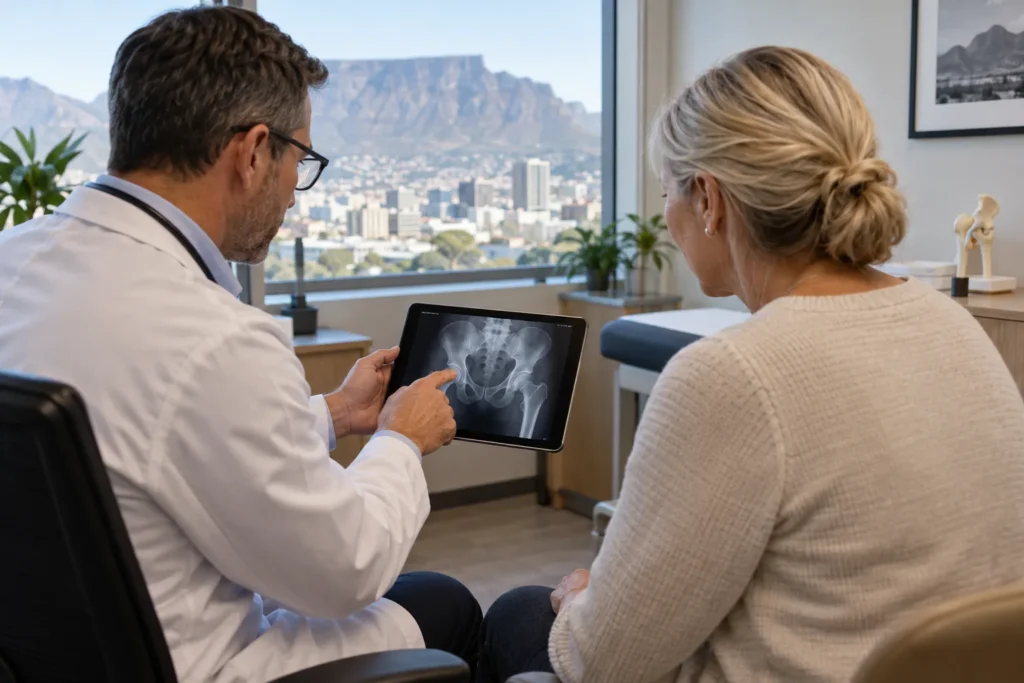
What hip pain may mean
The NHS notes that there are many possible causes of hip pain, from a sudden injury to a longer-lasting problem such as arthritis, and advises not to try to diagnose the cause yourself. It lists some patterns.
Pain, swelling or bruising after intense or repetitive exercise may be a sprain, strain or tendonitis. In people over 45, pain that is worse when walking with stiffness after moving may be osteoarthritis. Pain that may spread to the thigh and feel worse when lying on your side may be bursitis.
The American Academy of Orthopaedic Surgeons describes osteoarthritis of the hip as a common wear-and-tear condition that causes pain and stiffness.
The pain is most often felt in the groin or thigh and may spread to the buttock or knee, and it may be worse in the morning or after sitting or resting for a while. It can make everyday tasks such as bending to tie a shoe, rising from a chair or taking a short walk hard.
Some situations need urgent care. The NHS lists severe hip pain after a fall or injury, being unable to walk or put weight on the leg, and tingling or loss of feeling in the hip or leg after an injury as emergencies, so go to your nearest emergency unit in these cases.
The NHS also lists severe hip pain that started suddenly without a fall, a swollen hot hip, skin colour change around the hip, and hip pain with a high temperature or feeling generally unwell as reasons to see a doctor promptly.
Living well with a painful hip while you plan next steps
The NHS advises avoiding too much strain on the hip, but keeping moving if you can without overdoing it. It suggests an ice pack or bag of frozen peas wrapped in a towel for up to 20 minutes every 2 to 3 hours, and painkillers such as paracetamol or ibuprofen gel, or tablets if needed. Comfortable, shock-absorbing shoes with a soft sole may help.
It also suggests trying to lose weight if you are overweight, avoiding carrying anything heavy, and not sitting in low chairs, which can put extra pressure on the hips. The American Academy of Orthopaedic Surgeons likewise notes that losing weight can reduce stress on the hip joint, resulting in less pain and better function.
Walking supports can help some people. The American Academy of Orthopaedic Surgeons says that a cane, crutches or a walker can improve mobility and independence, and that aids such as a long-handled reacher help you avoid movements that may cause pain.
The NHS notes that an occupational therapist can help with things like walking sticks and other aids. A physiotherapist or occupational therapist can show you how to use them properly.
Keep track of how far you can walk comfortably and how your sleep is affected. This gives your specialist a useful measure over time.
The NHS advises seeing a doctor if hip pain stops you doing normal activities or affects your sleep, if it is getting worse or keeps coming back, if it has not improved after treating it at home for 2 weeks, or if you have stiffness for more than 30 minutes after waking.
How the decision about surgery is usually made
There is no single day when surgery becomes necessary. The decision rests on how much pain and loss of function you have, how long you have tried non-operative measures, what the X-rays show, and what matters to you. Treatments for hip pain listed by the NHS include simple exercises, physiotherapy, occupational therapy, steroid injections and referral to a specialist.
When surgery is discussed for an advanced worn hip, the most common operation is total hip replacement, in which the damaged socket and the ball of the thigh bone are replaced with artificial joint surfaces made of metal, plastic or ceramic. The American Academy of Orthopaedic Surgeons says the complication rate is low, with serious complications such as joint infection occurring in less than 2% of patients, but that complications can occur.
It lists infection, blood clots in the leg veins or pelvis, differences in leg length, and dislocation of the ball from the socket. Dislocation is uncommon, and the risk is greatest in the first few months while the tissues heal. Your surgeon will explain the risks, the type of implant and what recovery will involve for you.
Before any operation, it helps to prepare. Good control of other medical conditions and a clear plan for help at home support recovery. Ask what a realistic timeline is for your own situation.
Preparing for an appointment about hip pain
A little preparation makes the consultation more useful. Think about when the pain started and how it has changed, how far you can walk before you need to stop, and which everyday tasks have become difficult. Write down the medication you take, any earlier hip or back problems, and the results of previous scans.
Questions worth asking include what the most likely cause is, whether any scans are needed and why, which non-operative treatments are worth trying and for how long, and what signs would suggest that surgery should be considered. If surgery is raised, ask about the risks and the expected recovery timeline.
Bring someone with you if that helps, because information about treatment options can be a lot to take in at once. You are entitled to take time over the decision. A good consultation leaves you understanding your diagnosis, your choices and the next step.
Why an accurate diagnosis helps
Hip pain can have many causes, and treatment aimed at the wrong one rarely helps for long. An accurate diagnosis helps you avoid months of exercises or medication that do not suit the problem. It also helps you plan work, travel and activity around what your hip can currently manage.
If your hip pain affects your walking or sleep, book an assessment with an orthopaedic specialist in Cape Town. This article is general information and not a diagnosis, and any plan should come from the clinician who examines you.
Frequently Asked Questions
How do I know if hip pain is arthritis rather than a muscle strain?
You cannot reliably tell on your own, and the NHS advises not to diagnose the cause yourself. Osteoarthritis typically causes pain and stiffness that may be felt in the groin or thigh and is often worse after sitting or resting. Sprains, strains, tendonitis and bursitis can cause similar pain, so an examination is needed.
When does a hip specialist usually recommend hip surgery?
Surgery is generally considered when pain and loss of function continue despite a proper trial of non-surgical treatment such as exercise, physiotherapy, weight management and pain relief, and when imaging shows advanced joint damage. The decision is shared with you.
Can I still walk while waiting for assessment?
The NHS advises keeping moving if you can without putting too much strain on the hip or overdoing things. Avoid carrying heavy loads, and get urgent help for severe pain after a fall or if you cannot put weight on the leg.
Does hip surgery always mean a full replacement?
No. Many people are managed without surgery. When surgery is needed for an advanced worn hip, total hip replacement is the most common operation, but the right operation depends on your diagnosis, which your surgeon will explain.
How quickly can I return to promenade walks after hip surgery?
This varies from person to person and depends on the operation and your general health. Your surgeon and physiotherapist will give you a timeline. The American Academy of Orthopaedic Surgeons notes that the risk of dislocation is greatest in the first few months after a hip replacement, so follow the instructions you are given.
Related reading: Why Your Hip Hurts More in Cold Weather, and When to See a Hip Specialist.